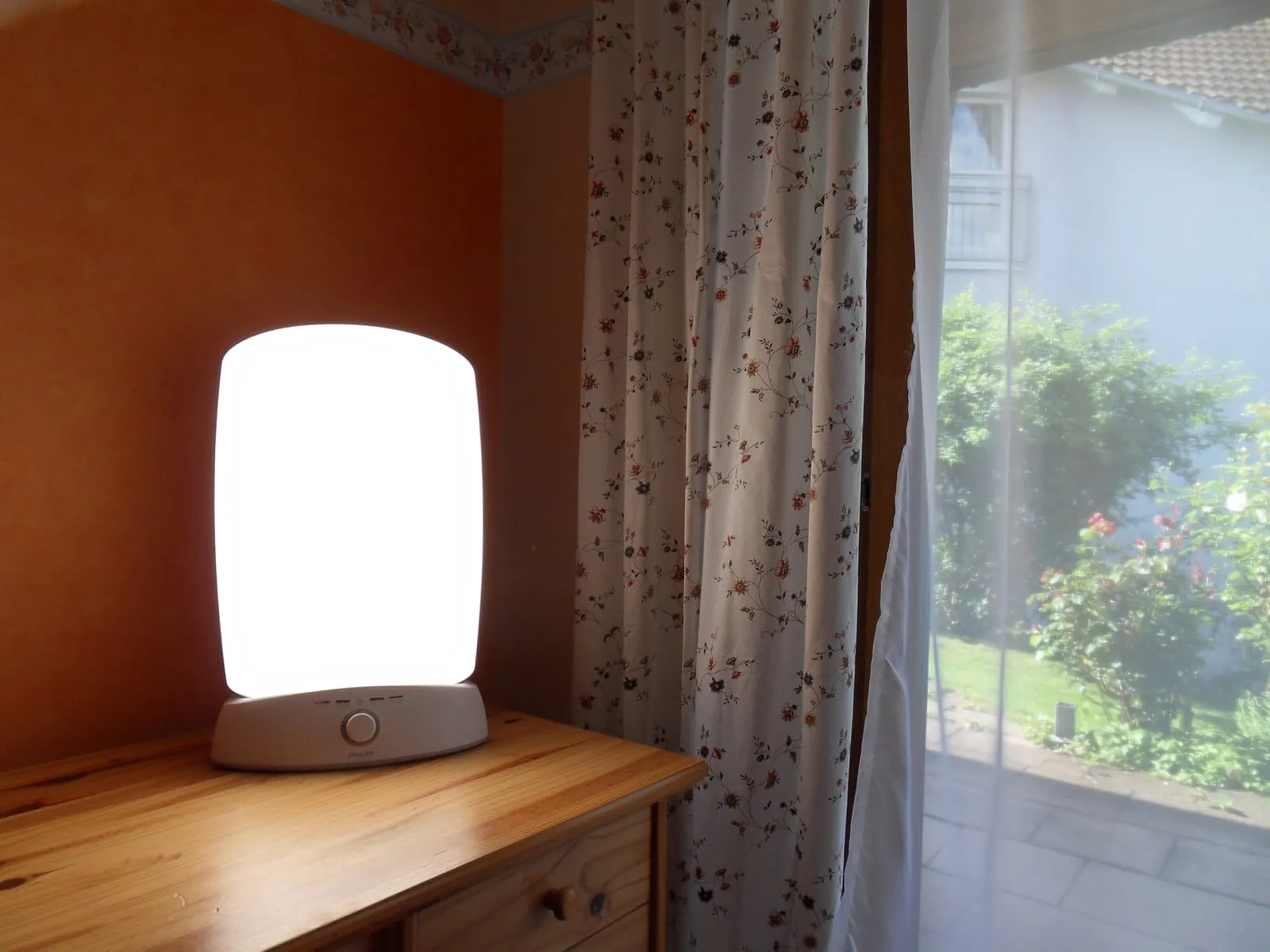

Quick answer: if you’re buying a light box for Washington’s dark months, look for one that delivers 10,000 lux at a stated distance, filters out UV light, and is big enough to sit in front of comfortably. That’s the setup the National Institute of Mental Health (NIMH) describes for seasonal affective disorder (SAD) [1]. Talk with a health care provider before you start; a lamp isn’t a diagnosis or a substitute for care.
Washington’s winter days are short. Using NOAA’s solar calculation method, Seattle and Spokane get about 8 hours 25 minutes of daylight on December 21, 2026, and Bellingham about 8 hours 16 minutes. Six months later, the same cities get close to 16 hours [2].
At a glance
- Seattle daylight, December 21, 2026
- About 8 hours 25 minutes [2]
- Bellingham daylight, December 21, 2026
- About 8 hours 16 minutes [2]
- Seattle daylight, June 21, 2027
- About 15 hours 59 minutes [2]
- Light box brightness NIMH describes
- 10,000 lux, about 30 to 45 minutes a day, usually in the morning [1]
- Who should check with a doctor first
- People with certain eye diseases or on medicines that increase sun sensitivity [1]
What NIMH says about light therapy
NIMH describes SAD as depression with a recurring seasonal pattern; in the winter pattern, symptoms can include oversleeping, overeating and pulling away from people, and they typically last four to five months a year [1]. Light therapy, as NIMH describes it, means sitting in front of a very bright light box (10,000 lux) for about 30 to 45 minutes every day, usually first thing in the morning, from fall to spring [1].
In a study NIMH cites, light therapy and a form of cognitive behavioral therapy for SAD were equally effective at improving symptoms, with some symptoms improving slightly faster with light [1]. NIMH says light boxes filter out UV light, which makes them safe for most people, but people with certain eye diseases or who take medications that increase sensitivity to sunlight may need other treatments or medical supervision [1]. SAD is also more common in people with bipolar disorder [1], so anyone with that diagnosis should talk to their provider first.
How we chose
- 10,000 lux, with the distance stated where possible. Brightness drops quickly as you move away; a lamp that names its distance is easier to use correctly.
- UV-free or UV-filtered light, per the maker [1].
- A safety approval or a long warranty from the maker.
- No recall. We searched the Consumer Product Safety Commission recall database for each brand on November 2, 2026 [7].
- No health claims from us. We list what each maker says about light output and build, not what a lamp will do for your mood.
Our picks
Best for: Using at a desk or table while you eat breakfast or read
Carex Day-Light Classic Plus (CCFDL93011)
It has a large 16 by 13 inch screen on an adjustable arm, so the light can sit above eye level, and Carex states the distance for 10,000 lux.
- 10,000 lux at 12 to 14 inches; 5,000 lux task setting [3]
- 16 x 13 in. screen, 192 LEDs, 4,000 K [3]
- Height adjusts 22 to 31 in.; angle 15° to 180° [3]
- 100% UV protection, per Carex [3]
- 5-year warranty [3]
Safety check: Carex lists no third-party safety certification on the product page [3]. Carex's only CPSC recall in the database is for bed rails, not lamps (checked 2026-11-02) [7].
Watch out: It's large and needs a table with room for the base. Carex's page makes health claims we can't verify; rely on NIMH's guidance instead.
See it on Amazon → We chose it from specs and safety records; we haven't tested it ourselves.
Best for: People who want a heavy-duty lamp with a long warranty
Northern Light Technologies BOXelite Desk Lamp
It's built in Canada with a metal housing and carries a 7-year warranty, the longest here. The maker states 10,000 lux at up to 14 inches.
- 10,000 lux at up to 14 inches [4]
- Two 36 W fluorescent tubes behind a UV filter [4]
- 17 x 12.25 x 2.5 in.; 8 lb [4]
- 7-year warranty [4]
Safety check: QAI safety approval, per the maker [4]. No CPSC recall found for Northern Light Technologies (checked 2026-11-02) [7].
Watch out: It uses fluorescent tubes, not LEDs, and at 8 pounds it's meant to stay put.
See it on Amazon → We chose it from specs and safety records; we haven't tested it ourselves.
Best for: A lighter, LED version of a long-warranty lamp
Northern Light Technologies LUXOR Desk Lamp
It has the same 7-year warranty and safety approval as the BOXelite but uses a 30-watt LED and weighs half as much.
- 10,000 lux at up to 12 inches [5]
- 30 W LED; no UV, per the maker [5]
- About 15 in. per side; 4 lb [5]
- 7-year warranty; made in Canada [5]
Safety check: QAI safety approval, per the maker [5]. No CPSC recall found for Northern Light Technologies (checked 2026-11-02) [7].
Watch out: You need to sit within about a foot of it to get 10,000 lux.
See it on Amazon → We chose it from specs and safety records; we haven't tested it ourselves.
Best for: Small apartments and tight budgets
Verilux HappyLight Luxe
It's thin and light, with brightness and color settings and a built-in timer, so it's easy to keep on a desk or counter.
- Up to 10,000 lux; UV-free LED light [6]
- 11.7 x 7.5 x 0.5 in.; 2 lb [6]
- 4 brightness levels; 3 color settings [6]
- Timer up to 1 hour in 5-minute steps [6]
- 3-year warranty [6]
Safety check: Verilux lists no third-party safety certification on the product page [6]. No CPSC recall found for Verilux (checked 2026-11-02) [7].
Watch out: Verilux doesn't say at what distance it reaches 10,000 lux, and the screen is the smallest here, so you'll likely need to sit close. Some colors were sold out on Verilux's site when we checked.
See it on Amazon → We chose it from specs and safety records; we haven't tested it ourselves.
Buying guide
- Check the distance for 10,000 lux. The lamps here range from 12 to 14 inches. Measure where it will sit relative to your face before you buy.
- Bigger screens are more forgiving. A larger light surface makes it easier to stay in the beam while you read or eat.
- Look for UV-free or UV-filtered light, as NIMH describes [1].
- Plan for mornings. NIMH describes using the light first thing in the morning, every day, from fall to spring [1]. Put it where you already spend that time.
Sources
- National Institute of Mental Health: Seasonal Affective Disorder
- NOAA Global Monitoring Laboratory: Solar Calculator (day length computed with NOAA's published method for Seattle, Spokane and Bellingham)
- Carex: Day-Light Classic Plus Light Therapy Lamp
- Northern Light Technologies: BOXelite Desk Lamp
- Northern Light Technologies: LUXOR Desk Lamp
- Verilux: HappyLight Luxe
- U.S. Consumer Product Safety Commission: Recalls (searched November 2, 2026)
Common questions
How much daylight does Washington get in winter?
By NOAA's solar calculations, Seattle and Spokane get about 8 hours 25 minutes of daylight on December 21, 2026, and Bellingham about 8 hours 16 minutes. On the June solstice the same cities get roughly 16 hours.
How is a light box used for seasonal affective disorder?
The National Institute of Mental Health describes sitting in front of a very bright light box, 10,000 lux, for about 30 to 45 minutes a day, usually first thing in the morning, from fall to spring. NIMH advises talking with a health care provider about benefits and risks before starting any treatment.
Are light therapy lamps safe for everyone?
NIMH says light boxes filter out UV light and are safe for most people, but people with certain eye diseases or who take medicines that increase sensitivity to sunlight may need another treatment or medical supervision.